


This MSA Blog features a Black History Month Special Repost from the High Museum of Art – Visit the original published content.
by Julia Forbes, Associate Director, Institutional Research, High Museum of Art
As the High approaches its centennial anniversary in October, we explore the museum’s desegregation.
“So, they told me there was some kind of a museum way out on Peachtree Street. I got a streetcar and rode out there.”
Sometime after his arrival in Atlanta in 1931, artist and Atlanta University art professor Hale Woodruff made a bold visit to the High Museum of Art. He recounted this experience in an interview in 1968:
And speaking of sit-ins and walk-ins, we did lots of things in those days which were generally unheard of then. They were unspeakable. When I first got to Atlanta, I wanted to find out what was going on in the way of art. . . . I faced an imposing mansion. There was a Negro janitor sweeping the sidewalk. He looked at me and I looked at him. I walked up the steps and went on into the building. To the receptionist, I said, “I want to see the Director.” She almost fainted. But she went in, and I met the Director. He and I had a very nice talk for about an hour that afternoon. When I came out the janitor saw me again and he said, “Come here, I want to tell you something.” I said, “What’s that?” He said, “You know, I’ve been at this place for I don’t know how many years, but you’re the first Black man beside me that’s ever walked through that front door.” I said, “Well, I won’t be the last one.”
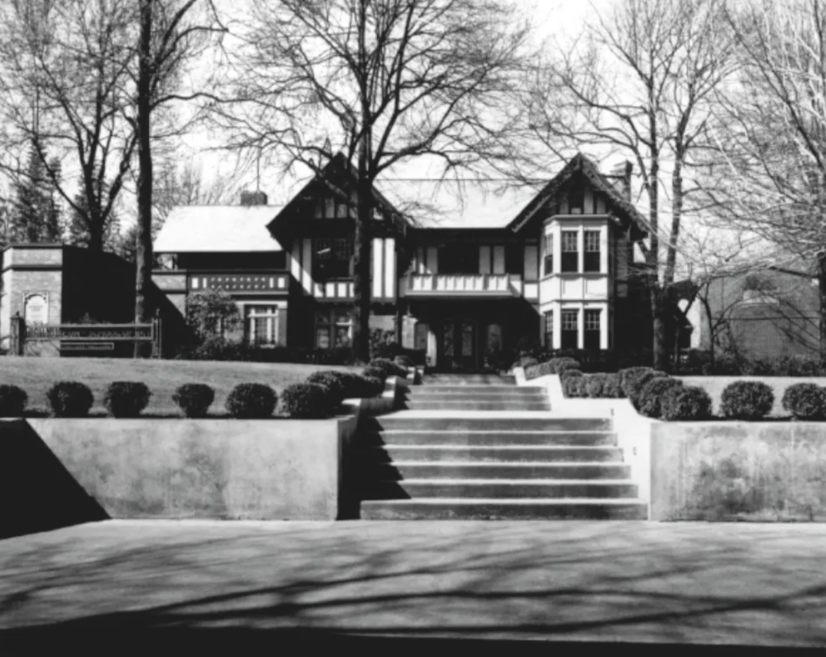 High Museum and School of Art, undated. Photo courtesy of the High Museum of Art Archives.
In 1931, the High Museum and School of Art was housed in the former home of Hattie High and had only been in existence since 1926. The director Woodruff met with that day was Lewis Palmer Skidmore, an artist himself. As Woodruff noted in the 1968 interview, “Now this I didn’t know, but it is significant now. Not that it was a great achievement, but in those days, people just didn’t do those things. You sort of kept ‘your place’ and eventually these things begin to flow together, racially. But those were very exciting days in Atlanta, and I think it’s because the schools there did try to develop some kind of direction in the arts, in sociology, in the social sciences and in the physical sciences. They had those things fairly well organized and directed.”
Hale Woodruff had been invited to Atlanta in 1931 for a groundbreaking new role: to start an art department at Atlanta University (now Clark Atlanta University). After their initial meeting, Woodruff and Skidmore developed an unlikely collegial relationship. Skidmore allowed Woodruff to occasionally bring his Black students to the museum after hours; Woodruff was invited to lecture at the School of Art; and Skidmore served on the jury for Woodruff’s newly formed art annuals. [4] An example of these after-hours viewings appears in a 1932 issue of Atlanta Daily World, advertising an evening opportunity (7 to 9 p.m.) to view an exhibition of Italian paintings lent by Samuel Kress and to attend a lecture by Skidmore.
Woodruff left Atlanta University for New York in 1946 to teach in the art department at New York University, and Skidmore retired in 1948. With Woodruff’s departure, the special relationship between these two men ended, which appears to have also ended the small collaborative efforts between the museum and the Black community. The Jim Crow laws that ruled throughout the South were also in place in Atlanta.
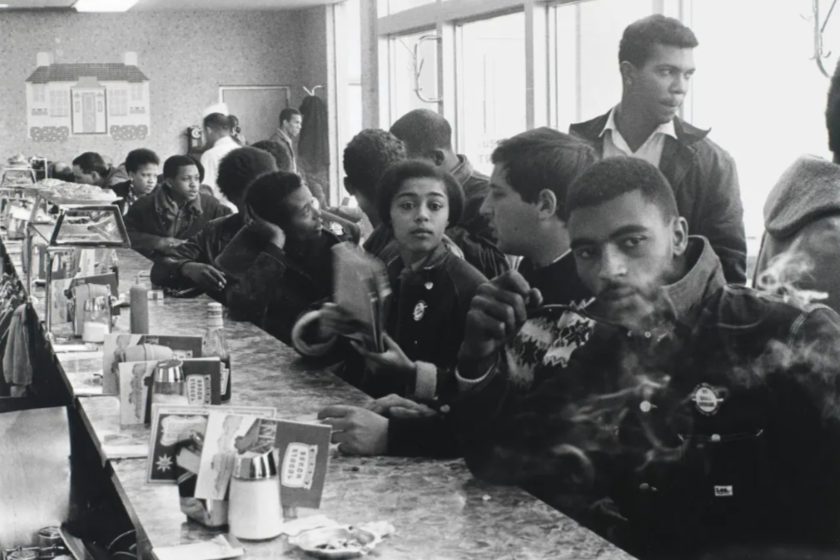 Danny Lyon (American, born 1942), SNCC Activists Sitting at a Lunch Counter, Atlanta, Winter 1963, 1963, gelatin silver print, High Museum of Art, Atlanta, purchase with funds from the H. B. and Doris Massey Charitable Trust and Lucinda W. Bunnen for the Bunnen Collection, 1994.65.
As illustrated in an impressive collection of civil rights photographs in the High’s holdings, a wave of student-led sit-ins swept the country in the early 1960s. This form of nonviolent civil disobedience, along with boycotts, disrupted daily operations of segregated businesses. The strategy inspired the creation of the Atlanta University Center’s Committee on the Appeal for Human Rights (COAHR) and the Student Nonviolent Coordinating Committee (SNCC). Atlanta’s downtown business district was central to sit-ins during the 1960s.
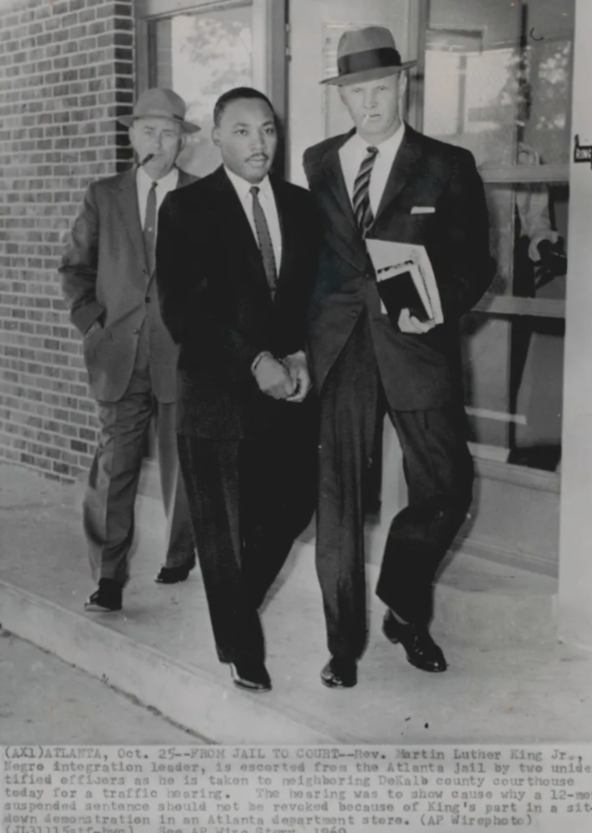 Photographer once known, Martin Luther King Jr. Is Escorted from the Atlanta Jail to a DeKalb County Courthouse on Oct. 25, 1960, 1960, gelatin silver print, High Museum of Art, Atlanta, purchase with funds from Sandra Anderson Baccus in loving memory of Lloyd Tevis Baccus, M.D., 2007.112.
Martin Luther King Jr. was arrested along with seventy-seven students during a student-led sit-in to integrate a Rich’s department store restaurant in Atlanta. All were released from jail except for King, who was charged with violating probation for a previous traffic offense of driving without a license — though he had a valid Alabama license at the time. He was sentenced to four months of hard labor, which garnered national attention. Presidential candidate Senator John F. Kennedy and Attorney General Robert Kennedy interceded on King’s behalf, and he was released on bond.
On October 1, 1962, Robert Kennedy shown a light on Atlanta again during a nationally televised NBC special report about the riots and violence around the integration of the University of Mississippi. Kennedy noted that Georgia was avoiding this sort of crisis thanks to state leaders, clergymen, and prominent citizens showing a sense of responsibility. He specifically highlighted the “great newspaperman, Ralph McGill” of the Atlanta Constitution and his many editorials for being among the most important voices in the South calling for an end to segregation.
Around the same time, the Atlanta Art Association (the parent organization of the High Museum and School of Art) experienced a devasting loss. On June 3, 1962, a plane carrying over one hundred members of the Association (who were returning from a tour of Europe’s great museums) crashed at Orly Field in Paris, killing all but one person, a flight attendant. Many members of the organization’s leadership were on the plane.
By late summer 1962, the new leadership of the Atlanta Art Association began discussions about desegregation. The executive committee unanimously approved a resolution on October 12. The minutes state, “it is the policy of the Atlanta Art Association to keep its Museums and Exhibits open to the general public at all times without any restrictions whatsoever as to race, creed, or color.”
On November 5, the Atlanta Art Association’s new director, Dr. Wilhelmus B. Bryan, sent a memo to the entire staff. It ended with this paragraph:
The museums, the schools, and all the facilities of the Association belong to the members of the Association, and they in turn have dedicated them to the use and enjoyment of the public. It is hoped that every employee will make himself an ambassador of goodwill for the Association, will devote himself to making every member, visitor, or other person using the Association’s facilities feel welcome and at home. It is the desire of the Trustees to encourage a much broader use of our facilities by the art lovers of the community, by the professional and the amateur artists of the community, and by the art students of the community. We want these facilities to be a place where these people love to come to browse, to study, to understand, and to appreciate the fine arts in their broadest sense.
In January 1963, the first three Black students were admitted to the Atlanta School of Art. By 1967, a steady series of special exhibitions featuring the work of Black artists were mounted at the museum, including the work of curator David C. Driskell, whose groundbreaking traveling exhibition Two Centuries of Black American Art was shown in 1977. In 2005, the High established the first national prize to recognize the importance of African American artists and curators and named it for Driskell. The annual gala fuels the David C. Driskell African American Art Acquisition Restricted and Endowment Funds, which support the acquisition of African American art as well as exhibitions and education programs presenting the work of Black artists.
In 1980, the man who had made the bold ascent up the stairs to the imposing mansion on Peachtree Street died, but he had lived to see his 1931 prediction come true. Indeed, Hale Woodruff was not the last Black person to enter the High Museum of Art. Today the High’s audience is more than fifty percent people of color and reflects the diverse community we serve.
About Julia Forbes
 Julia Forbes is the Associate Director, Institutional Research at the High Museum of Art in Atlanta, Georgia. She is responsible for designing, implementing, and reporting on quantitative and qualitative research studies regarding the High Museum’s impact, with the goal of positioning the High as one of the nation’s leading knowledge-producing art museums.